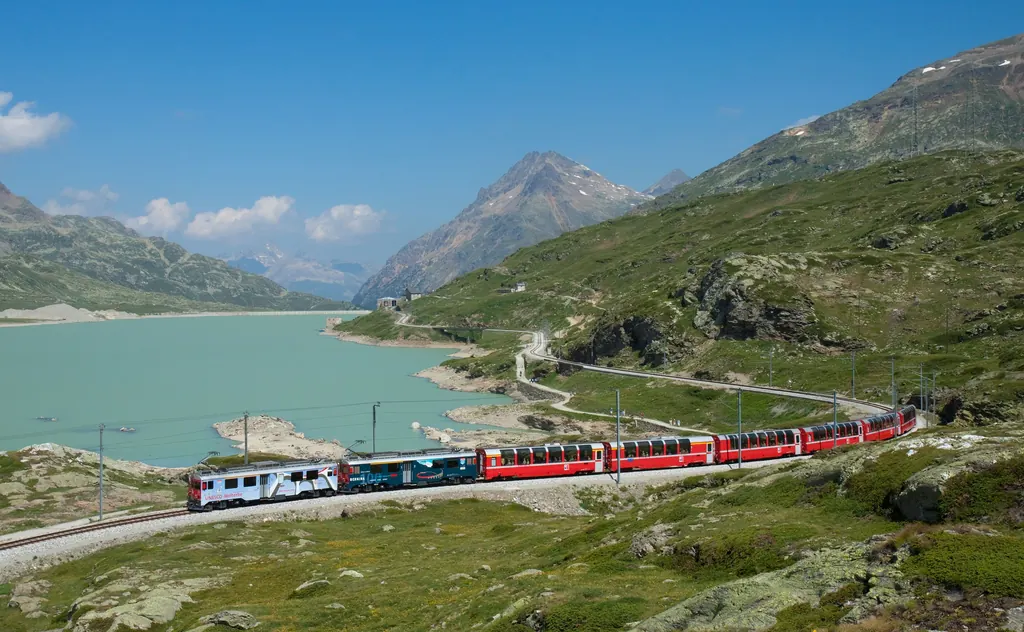
- Summits
- Bernina Express
Chur – Bernina Pass 2,253 m – TiranoBernina Express
From the oldest town in Switzerland, over 196 bridges and through 55 tunnels, up to the glaciers and down to the palm trees. Here is what the journey costs in 2026, when the train runs – and when the regional train on the same tracks is the better choice.
CHF 66 ticket + CHF 44 seat reservation
Low season CHF 40 reservation · with Swiss Half Fare Card (Halbtax) CHF 33 + reservation
- Chur 585 m
- Landwasser Viaduct
- Albula Tunnel 5.86 km
- Ospizio Bernina 2,253 m
- Tirano 429 m
- Journey time
- approx. 4 hrs
- From Chur, summer
- 08:17 · 13:34
- From Chur, winter
- 08:17
- Reservation
- compulsory
Fares and timetable checked on 21 September 2026 · valid for the timetable year to 12 December 2026 · Source: Rhaetian Railway · Photo: Kabelleger / David Gubler, CC BY-SA 3.0
Three pieces of advice up front
Reserve the seat first, buy the ticket later.
The seat reservation is compulsory and on popular days is often gone well in advance. According to RhB (the Rhaetian Railway), you can easily buy the ticket itself later – what matters is that you have both when you board.
Travel midweek.
From Monday to Thursday the Bernina line is quieter. From Friday to Sunday it is mainly the afternoon trains that are full heading south, and the morning trains heading north.
No seats left? Take the regional train.
It runs the same route, costs no supplement, and the windows open. You are not sitting in a panoramic car – but you see the same mountains.
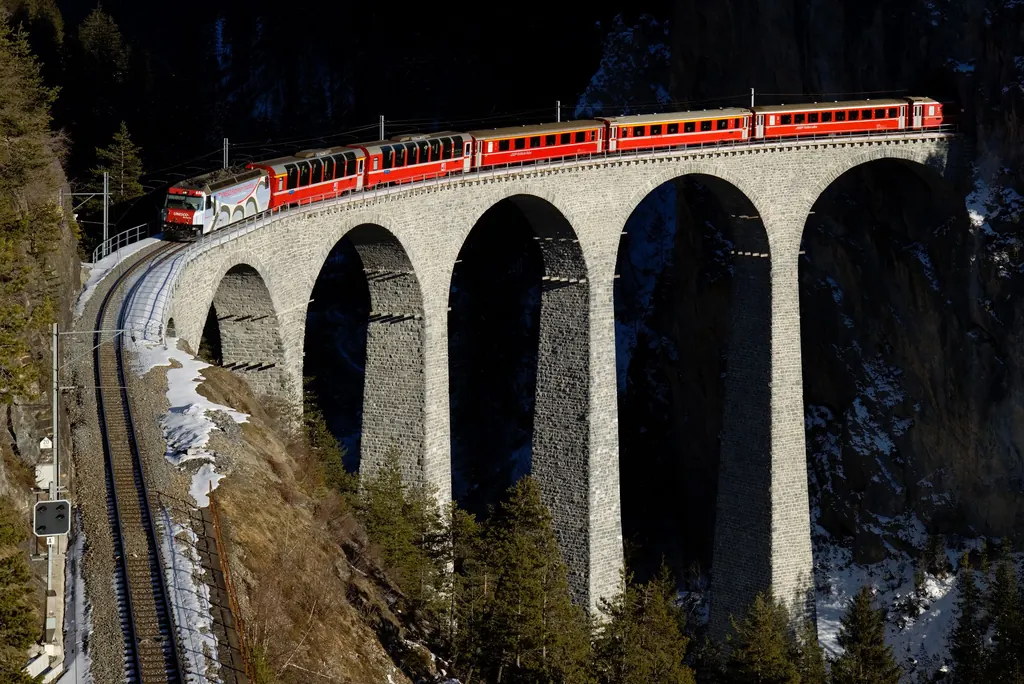
65 metres above the river.136 metres long, five piers of dark limestone – and at the end of the curve the train disappears straight into the rock.
Where are you starting from?
The whole route from Chur, half of it from St. Moritz, or uphill from Tirano. Your starting point decides the price, the supplement and the journey time.
The whole route: Albula and Bernina in one train
From Chur you travel both World Heritage lines in one go – first through the Albula valley with the Landwasser Viaduct, then over the Bernina Pass. In summer (2 May to 25 October 2026) there are two trains: at 08:17, arriving in Tirano at 12:49, and at 13:34, arriving at 18:00. In the winter timetable only the 08:17 train runs.
- Ticket 2nd class
- 66 CHF
- Reservation summer
- 44 CHF
- Reservation winter
- 40 CHF
- Journey time
- approx. 4 hrs
Honestly: There and back in a day from Chur means: leave at 08:17, leave Tirano again at 14:24, back at 18:31 – a good eight and a half hours on the train, one and a half in Tirano. A night in the south is nicer, or returning by bus to Lugano.
The short route: just the Bernina Pass
From St. Moritz a separate Bernina Express runs to Tirano in around 2 hours 15 minutes – in summer at 09:17, 13:17 and 16:14. You save half the fare and pay a lower supplement. What is missing is the Albula line with the Landwasser Viaduct and the spiral tunnels.
- Ticket 2nd class
- 33 CHF
- Reservation
- 32 CHF
- Journey time
- 2:15 hrs
Honestly: A CHF 32 supplement on a CHF 33 ticket almost doubles the price. Regional trains run on this section too – there the optional reservation costs CHF 5.
Uphill: from the palm trees to the glacier
From Tirano the Bernina Express runs in summer at 08:06 and 14:24 to Chur, and at 10:06, 13:17 and 16:06 to St. Moritz. Fares and supplements are the same as in the opposite direction. How to get there from Milan, and whether it works as a day trip, is covered on the page Bernina Express from Milan.
“I’m in Tirano and want to book the ticket in advance, in English and in euros.”Tirano to St. Moritz: Bernina Red Train Return Day-Ticket
Honestly: With RhB, Tirano – St. Moritz return costs CHF 66. And: according to RhB, “Bernina Red Train” usually means the regional train, not the panoramic car. The extra money buys you convenience, not a better train.
From Milan: Bernina Train and St. Moritz Day Trip
Honestly: You only travel by rail on the section between Tirano and St. Moritz. It is a long day. Read the listing to see whether a seat in the panoramic car is guaranteed – many tours use the regional train. If you are in Graubünden anyway, you do not need a tour.
One ticket, one supplement – and four ways to bring the total down
The Bernina Express has no fare of its own. You buy a normal ticket for the route plus the compulsory seat reservation. Passes only reduce the ticket – the supplement stays the same for everyone, children included. All prices are in Swiss francs (CHF), not euros.
| How you travel | Ticket | Reservation | Total |
|---|---|---|---|
| Bernina Express, full fare | CHF 66 | CHF 44 | CHF 110 |
| Bernina Express with Swiss Half Fare Card (Halbtax – the Swiss Half Fare Card is the version for visitors from abroad) | CHF 33 | CHF 44 | CHF 77 |
| Bernina Express with GA, Swiss Travel Pass, Interrail or Eurail | in the pass | CHF 44 | CHF 44 |
| Child aged 6–16 (under 6 free, supplement still in full) | CHF 33 | CHF 44 | CHF 77 |
| Regional train on the same route (with changes, windows that open) | CHF 66 | – | CHF 66 |
| Regional train with Swiss Half Fare Card | CHF 33 | – | CHF 33 |
In the low season the reservation costs CHF 40 instead of CHF 44, from St. Moritz CHF 32 all year. On the regional train between St. Moritz and Tirano, RhB recommends an optional reservation for CHF 5. For the spontaneous there is a last-minute offer: Chur – Tirano – Chur in 2nd class for CHF 125 including both reservations, online no earlier than six days ahead. All classes, routes and worked examples are on the page Bernina Express prices; how to book is under tickets and reservation.
Beyond Filisur the mountain begins.
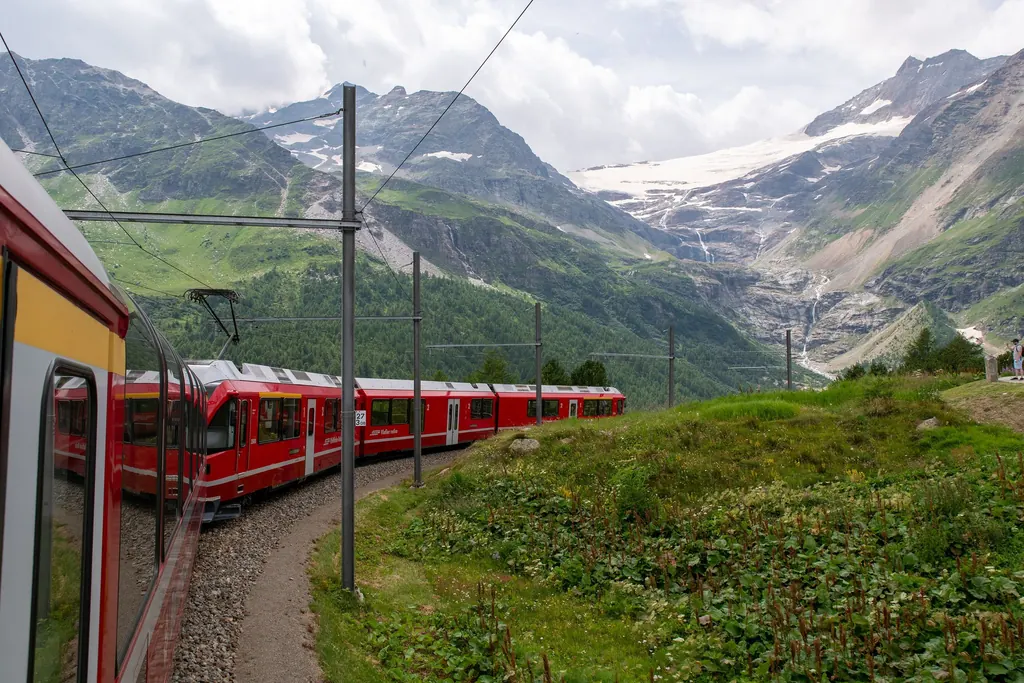
From Thusis onwards you are travelling through UNESCO World Heritage. After the Landwasser Viaduct the line winds its way up via Bergün through spiral tunnels to Preda and there dives into the Albula Tunnel – the new one, 5.86 kilometres long, in service since June 2024. On the other side lies the Engadine. You will find the course of the line with all its stations on the page about the Bernina Express route.
- 122 kmWorld Heritage route Thusis – Tirano
- 196bridges between Chur and Tirano
- 55tunnels
- 65 mheight of the Landwasser Viaduct
- 5.86 kmAlbula Tunnel at around 1,800 m
Honestly: From 29 October to 13 November 2026, trains 951 and 952 are diverted via Klosters and the Vereina Tunnel because of engineering works. In those two weeks you see neither the Landwasser Viaduct nor the Albula Tunnel – the supplement stays the same. Better to postpone.
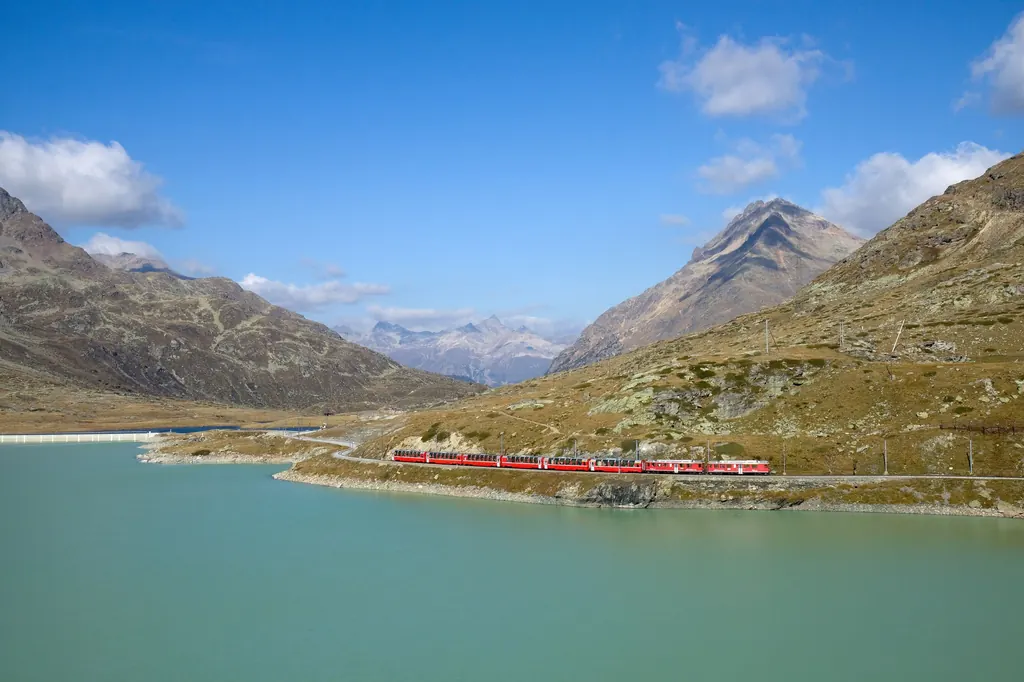
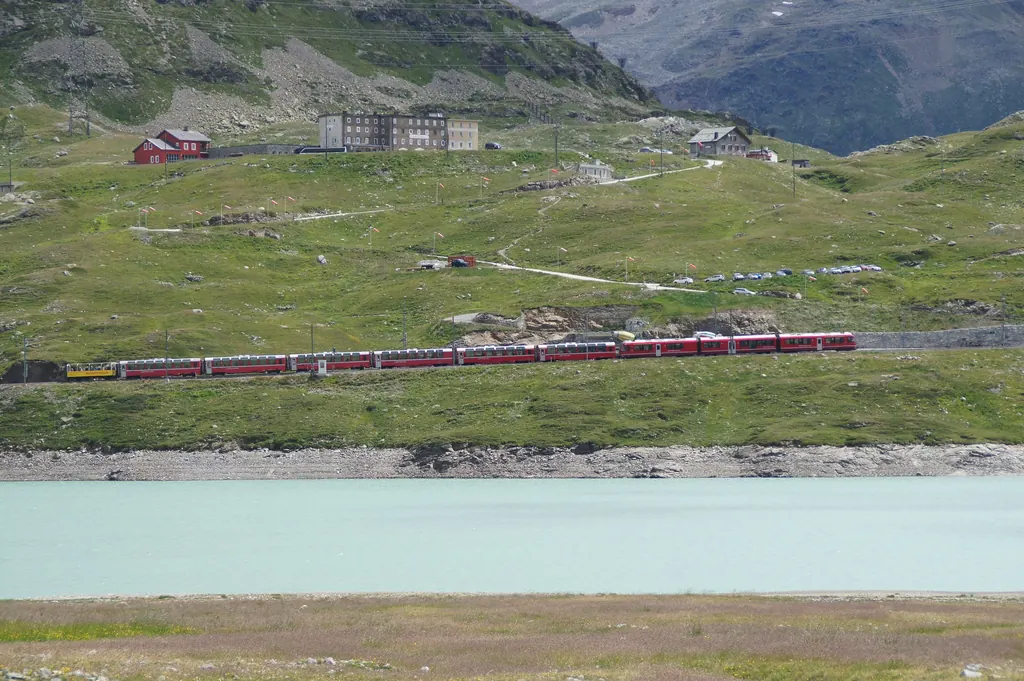
This is the top.No tunnel under the pass: the railway runs over the summit in the open, along the lake.
A seven per cent gradient, no rack rail.
From Pontresina the train climbs past the Morteratsch Glacier to Bernina Diavolezza station and on to Lago Bianco. The railway manages gradients of up to 70 per mille on wheel grip alone – RhB calls it the highest railway crossing of the Alps and one of the steepest adhesion railways in the world.
- Pontresina
- 1,774 m
- Bernina Diavolezza
- 2,082 m
- Ospizio Bernina
- 2,253 m
- Steepest gradient
- 70 ‰
In the panoramic car the windows reach up to the edge of the roof, but they do not open. What that means for photos, and how 1st and 2nd class differ, is on the page seats and panoramic cars.
From here it is downhill all the way.
Ospizio Bernina is the highest station on the Rhaetian Railway. Between here and Tirano lie 1,824 metres of descent.
Is the Bernina Express worth it?
The route is almost always worth it. The question is whether you want to pay a CHF 32 to 44 supplement for the panoramic car.
Take the Bernina Express if …
- you want to travel through without changing. Chur – Tirano in one train only exists this way.
- you need a guaranteed seat. With the reservation your seat on the chosen train is secure.
- comfort matters to you. Air conditioning, sockets, Wi-Fi, at-seat service and windows up into the roof.
Take the regional train if …
- you want to take photographs. The windows open there – no reflections in the picture.
- you would like to get off along the way. The Bernina Express reservation is valid only for the one train you booked.
- the clouds are sitting on the pass. A CHF 44 supplement for fog outside the panoramic window is too much. Without a reservation you decide in the morning.
- you are travelling with a bike. You cannot load your own bike on the Bernina Express.
Before you travel: watch the Rhaetian Railway livestream ↗ · Different departures apply in winter – see Bernina Express in winter.
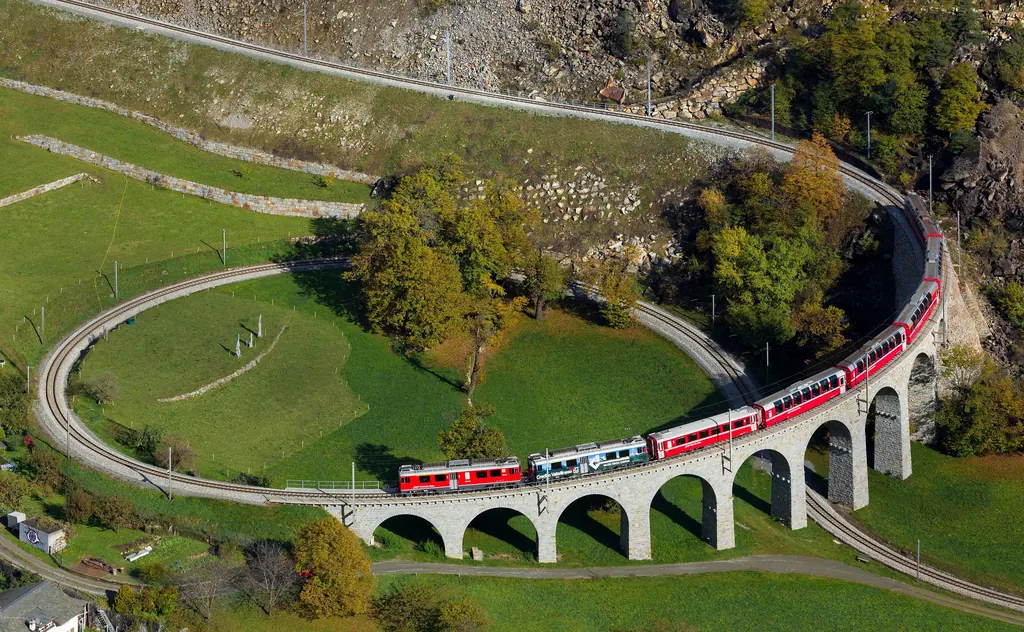
Once round in a circle, to lose height.Nine stone arches, one full 360-degree turn – the train passes underneath its own track.
From the glacier to the palm trees in a good hour and a half.
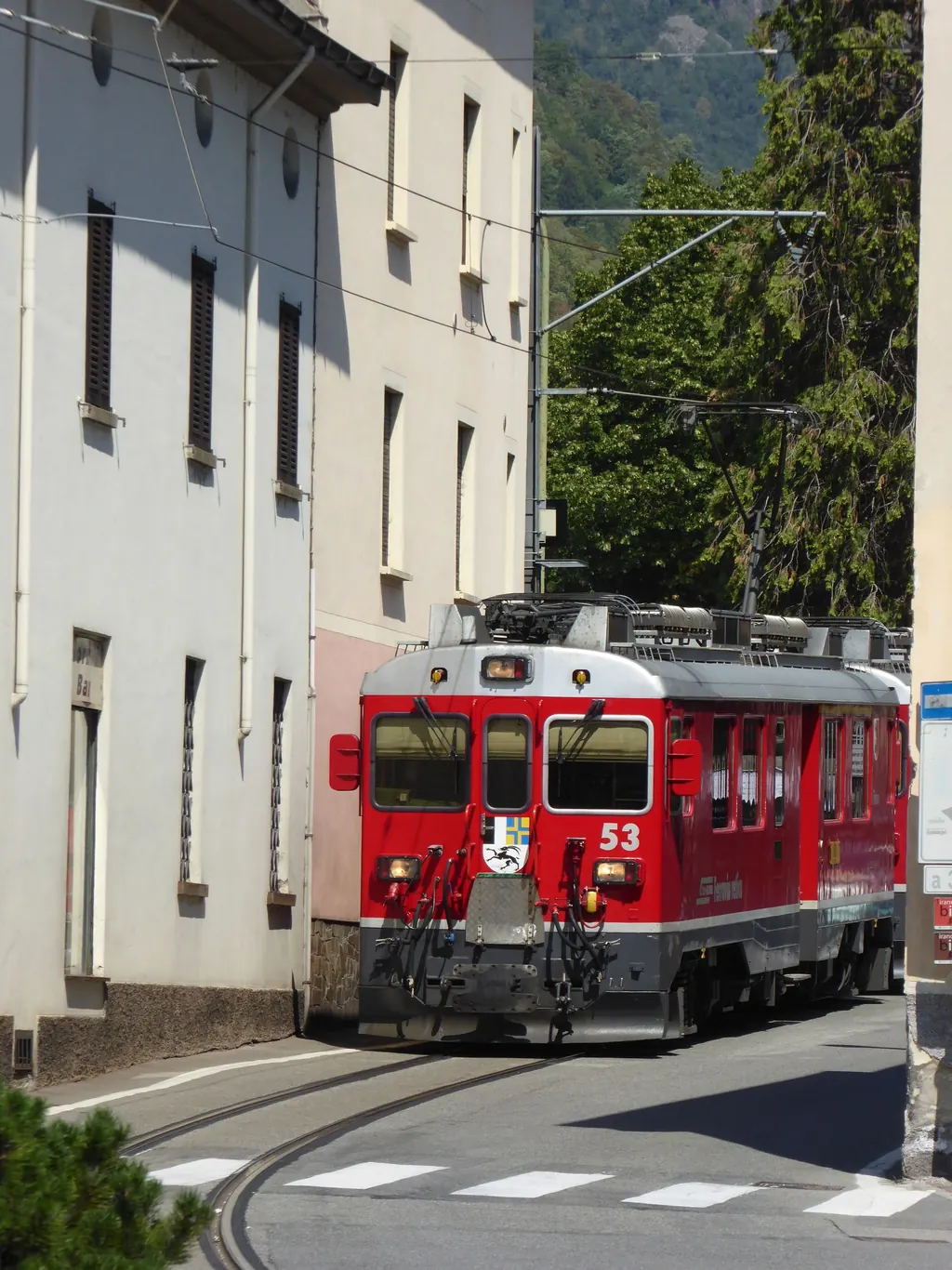
Beyond the pass comes Alp Grüm with its view of the Palü Glacier – a station with no road access. Then the line drops into Val Poschiavo, via Poschiavo and Le Prese, round the Brusio Spiral Viaduct and across the border. In Tirano the train rolls through the town to the station.
- Alp Grüm
- 2,091 m
- Poschiavo
- 1,014 m
- Brusio
- 780 m
- Tirano
- 429 m
Tirano is in Italy: take your passport or identity card, and for the dog the papers for crossing the border. If you do not want to go back the same way, the Bernina Express Bus continues to Lugano in a good three hours (departs Tirano 14:20, arrives Lugano 17:30; CHF 41 plus CHF 16 to 18 reservation) – or compare beforehand whether the Glacier Express would be the better fit.
If you are coming from Italy
The RhB fare is given above. These three offers solve a different problem: getting there from Milan without planning it yourself. All of them travel only the section between Tirano and St. Moritz.
From Milan to the Swiss Alps: Bernina Red Train & St. Moritz
From Milan: St. Moritz and Bernina Express Tour
From Milan: Lake Como Cruise, St. Moritz & Bernina Red Train
Honestly: Tirano – St. Moritz costs CHF 33 with RhB, plus a CHF 32 reservation on the Bernina Express. The tours cost two to three times as much because the transfer from Milan and a guide are included. Only the middle offer explicitly advertises a guaranteed panoramic car – check that with the provider before booking.
Where the figures come from
| Detail | Source | Checked |
|---|---|---|
| Fares, seat reservation fees, 2026 timetable, 196 bridges and 55 tunnels, journey time, bus to Lugano, children, dogs, bikes, diversion via Vereina | Rhaetian Railway: Bernina Express | 21 September 2026 |
| Last-minute offer, 1st and 2nd class facilities | Rhaetian Railway: Bernina Express Last Minute | 21 September 2026 |
| Regional train: windows that open, optional reservation CHF 5, “Bernina Red Train”, buying the ticket later | Rhaetian Railway: Bernina Express or regional train? | 21 September 2026 |
| How busy trains are by day of the week and time of day | Rhaetian Railway: a relaxed trip on the Bernina line | 21 September 2026 |
| Albula Tunnel, UNESCO World Heritage since 2008, highest railway crossing of the Alps | Rhaetian Railway: Albula line and UNESCO railway lines | 21 September 2026 |
| 122 km World Heritage route, Landwasser Viaduct (65 m, 136 m, 5 piers), spiral viaduct (9 arches, 360°), ID for Italy | Switzerland Tourism (in German) | 21 September 2026 |
| Alp Grüm: reachable only by rail, on foot or by bike, 2,091 m | Graubünden Ferien: Alp Grüm | 21 September 2026 |
| 70 per mille without rack rail, Ospizio Bernina 2,253 m, Tirano 429 m | Engadin Tourismus: panoramic journeys (in German) | 21 September 2026 |
| Altitudes of all stations (rounded) | DiDok station register, SBB Open Data | 21 September 2026 |
| Halbtax, Swiss Half Fare Card | SBB | 21 September 2026 |
| Tour prices, ratings | GetYourGuide, partner data | 21 September 2026 |
Photo credits
- Cover photo, Bernina Express at Lago Bianco: Kabelleger / David Gubler, CC BY-SA 3.0
- Landwasser Viaduct: Kabelleger / David Gubler, CC BY-SA 3.0
- Train at Lago Bianco: Kabelleger / David Gubler, CC BY-SA 3.0
- Brusio Spiral Viaduct: Kabelleger / David Gubler, CC BY 3.0
- Train in Tirano: Abxbay, CC BY-SA 4.0
- Bernina Express at Ospizio Bernina: Markus Giger, CC BY-SA 4.0
- Alp Grüm with the Palü Glacier: Hansueli Krapf, CC BY-SA 4.0


Links to GetYourGuide are adverts: if you book through them, we receive a commission and you pay the same price. We always state the operator’s fare first. Prices change – what counts is what the provider shows.