- Summits
- Bernina Express
- Glacier Express: route
Glacier Express · course of the lineThe route from Zermatt to St. Moritz
291 kilometres through Valais, Uri and Graubünden, in around eight hours. The route drops from Zermatt to Brig, climbs over the Oberalp Pass at 2,033 m, descends to Chur at 585 m and climbs back up into the Engadine on the Albula line.
- Zermatt → Brig 1,604 → 670 m
- Andermatt → Oberalp Pass 2,033 m
- Chur → St. Moritz 585 → 1,775 m
- Summer
- 2 May – 10 Oct
- Break
- 11 Oct – 4 Dec
- Winter
- from 5 Dec
Checked on 21 September 2026 · Source: Glacier Express AG · Photo: Kabelleger / David Gubler, CC BY-SA 3.0
Glacier Express route: the line at a glance
The Glacier Express has linked Zermatt with St. Moritz since 25 June 1930. It runs on the tracks of two railways, the Matterhorn Gotthard Bahn in the west and the Rhaetian Railway in Graubünden. Each holds half of Glacier Express AG. The average speed is 42 km/h, the steepest gradient 12.5% – the pace is part of the concept.
- Length
- 291 km
- Highest point
- 2,033 m
- Lowest point
- 585 m, Chur
- Bridges
- 291
- Tunnels
- 91
- Rack section
- 31.9 km
Stations and journey times: the route plan
The through trains stop only at the major stations. As an example, PE 902 in the 2026 summer timetable – that is also the train with Excellence Class:
| Stop | Altitude | Arr. | Dep. |
|---|---|---|---|
| Zermatt | 1,604 m | – | 08:52 |
| Brig | 670 m | 10:06 | 10:14 |
| Andermatt | 1,435 m | 11:46 | 12:00 |
| Oberalp Pass (no stop) | 2,033 m | – | – |
| Disentis | 1,130 m | 13:02 | 13:14 |
| Chur | 585 m | 14:25 | 14:34 |
| Filisur (change to and from Davos) | – | 15:41 | – |
| Samedan (alighting only) | – | 16:29 | – |
| St. Moritz | 1,775 m | 16:37 | – |
In summer three through trains leave Zermatt (07:52, 08:52 and 09:52), plus an afternoon train from Brig at 14:14 that arrives in St. Moritz at 20:55 and also stops at Thusis, Tiefencastel, Bergün and Celerina on the way. In the opposite direction trains leave St. Moritz at 08:38 and 09:38 for Zermatt. In the winter timetable from 5 December 2026 to 7 May 2027 there are two trains in each direction, and one of them runs only from 12 December to 3 January and from 30 January to 7 May. From 11 October to 4 December 2026 the Glacier Express does not run at all.
Section 1: Zermatt – Brig, down through the Matter valley
The journey begins with the descent: from 1,604 m in Zermatt to 670 m in Brig. About ten minutes after departure you see, on the left in the direction of travel, the roughly 3.5-kilometre-long Bis Glacier above Randa. At Kalpetran the railway and the River Vispa squeeze together through the Kipfen Gorge (1,074 m); at Stalden comes the Neubrück bridge of 1922. Brig is the main town of German-speaking Valais and the first longer stop.
Section 2: Brig – Andermatt – Oberalp Pass, the highest point
Beyond Brig the line climbs through the Goms. It passes beneath the Furka Pass through the Furka Base Tunnel, at 15.4 kilometres the longest tunnel on the route. Only since it opened on 26 June 1982 has the Glacier Express been able to run all year. Shortly before Andermatt lies Zumdorf, according to the operator the smallest village in Switzerland.
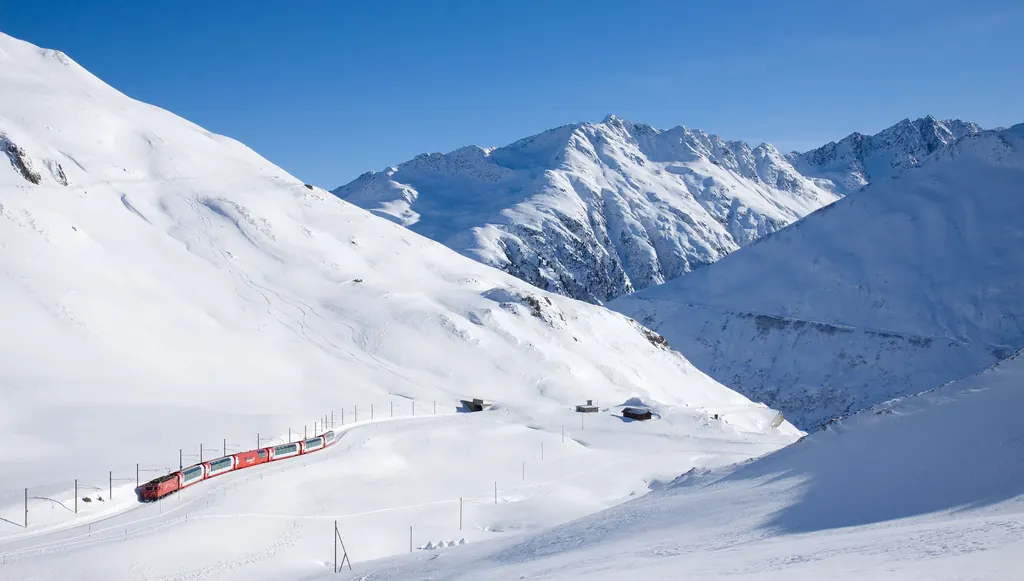
From Andermatt (1,435 m) the train climbs to the Oberalp Pass at 2,033 m, the highest point of the journey. At the top is a lake, in winter under a blanket of snow several metres deep – and on the pass stands a lighthouse. It marks the source of the Rhine at Lake Toma a little higher up.
Section 3: Disentis – Rhine Gorge – Chur
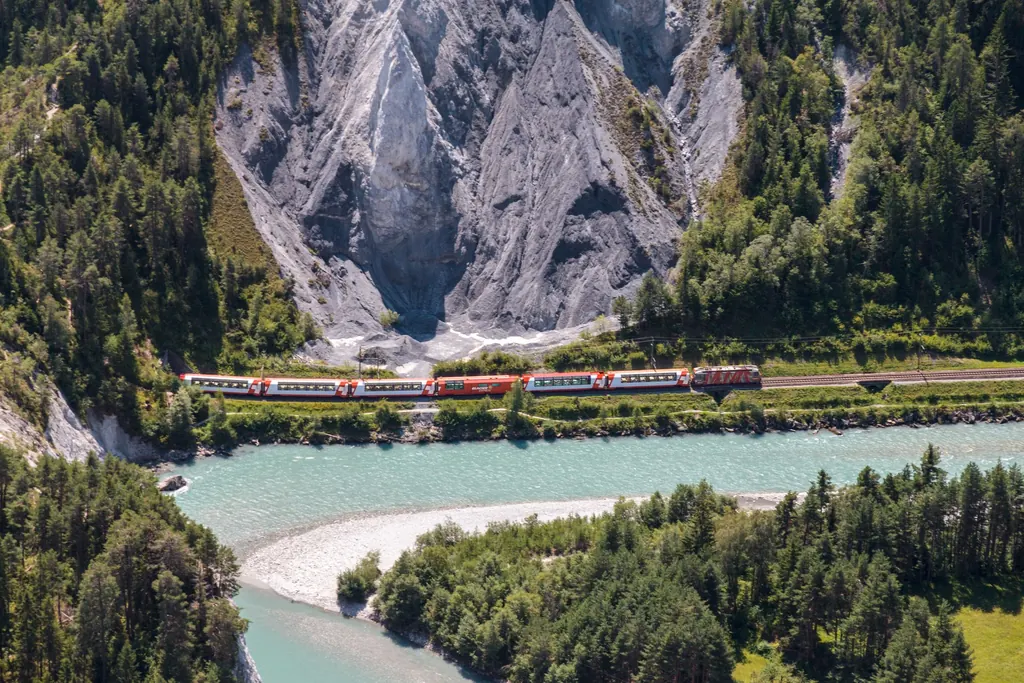
Heading down the valley comes Disentis (1,130 m) with its Benedictine monastery, more than 1,400 years old. Between Ilanz and Reichenau the train runs through the Rhine Gorge, called the “Swiss Grand Canyon” by the operator: white cliffs, formed after a rockslide around 10,000 years ago. At about 630 m this is almost the lowest section. Chur, at 585 m, is lower still.
Section 4: Chur – Albula line – St. Moritz
From Thusis the Glacier Express runs on the Albula line, which together with the Bernina line has been UNESCO World Heritage since 2008. On this stretch it gains more than 1,000 metres in height. First comes the Solis Viaduct (85 m high, eleven limestone arches), and shortly before Filisur the Landwasser Viaduct: 65 m high, 142 m long, on a curve straight into the tunnel. Between Bergün and Preda the railway overcomes more than 400 metres of height with six viaducts, three spiral tunnels and two horseshoe tunnels. Then the Engadine opens up; the terminus is St. Moritz at 1,775 m.
The Bernina Express travels the same section between Chur and the Engadine – it then turns off over the Bernina Pass to Italy. How the two trains differ and can be combined is in the comparison Bernina Express vs Glacier Express.
Which part of the route is worth it if eight hours is too much?
You do not have to travel the whole route: tickets are also available for sections, such as Chur – Andermatt (CHF 53 in 2nd class), Andermatt – Brig (CHF 37) or St. Moritz – Chur (CHF 44). The reservation, however, always costs CHF 54, no matter how short your journey. All fares are on Glacier Express prices.
Honestly: The Glacier Express does not have the route to itself. Ordinary Matterhorn Gotthard Bahn trains also run over the Oberalp Pass from Andermatt to Disentis, and for the Rhine Gorge the Rhaetian Railway sells its own Rhine Gorge ticket (Rheinschlucht-Ticket) for hopping on and off by train and PostBus (from Chur CHF 42, with Swiss Half Fare Card (Halbtax) CHF 21). There you pay no CHF 54 reservation, but you are not sitting in a panoramic car. If you only want to see one of these sections, look at the SBB timetable first.
Rule of thumb: The whole route only if the train ride is your programme for the day. Otherwise pick the section that appeals to you – Oberalp, Rhine Gorge or Albula – and travel that.
Where the figures come from
| Detail | Source | Checked |
|---|---|---|
| Sights along the route, Oberalp Pass 2,033 m, Bis Glacier, Kipfen Gorge, Furka Base Tunnel 1982, Rhine Gorge, viaducts, Albula line | Glacier Express, route | 21 September 2026 |
| Elevation profile of all places, lowest point Chur 585 m, Furka tunnel 15.4 km, 31.9 km rack section | Glacier Express AG, sales manual 2025 (PDF) | 21 September 2026 |
| 291 km, 291 bridges, 91 tunnels, 42 km/h, first journey 1930, owners | Glacier Express, about us | 21 September 2026 |
| Summer and winter timetable 2026/27, stops, seasonal break | Glacier Express, 2026 timetable | 21 September 2026 |
| Rhine Gorge ticket, prices | Rhaetian Railway, Rheinschlucht-Ticket | 21 September 2026 |
| Prices for sections, reservation CHF 54 | Glacier Express, prices | 21 September 2026 |