- Summits
- Koblenz Cable Car
- Deutsches Eck
Where the Moselle meets the RhineDeutsches Eck
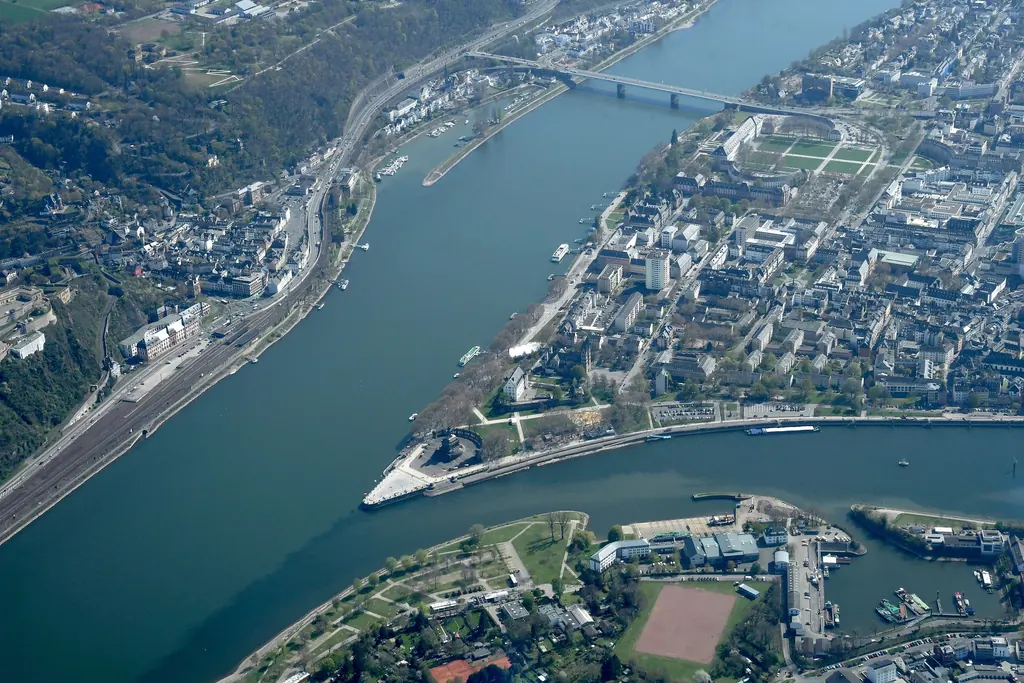
A headland, a 37-metre monument and more than two million visitors a year. Down here you stand on it – to see why it is called a “corner” you have to look from above. The cable car’s lower station is a few steps away.
14 m of it the equestrian statue
from 17:30 €9.90
- Named in
- 1216
- Inaugurated
- 31 Aug 1897
- Rebuilt
- 1993
- World Heritage
- since 2002
Checked on 22 September 2026 · Sources: Koblenz-Touristik, Seilbahn Koblenz · Photo: Carsten Steger, CC BY-SA 4.0
Why it is called the German Corner
The name is older than the monument and has nothing to do with the German Empire. In 1216 the Teutonic Order – the Deutscher Orden – settled at the confluence of Rhine and Moselle, hence “Deutsches Eck”, the German Corner. The city owes its name to the same spot: the Latin “Castellum apud Confluentes”, the fort by the merging rivers, became Koblenz over the centuries.
The headland itself is a public square on the Konrad-Adenauer-Ufer, behind the basilica of St Castor. The Moselle comes in from the left, the Rhine from the right, and at the tip you can walk right down to the water.
Honestly: From down here you don’t see the confluence – you are standing on it. Two rivers arriving from two directions and becoming one in front of you: that only shows from above, from the cabin of the cable car or the wall of Ehrenbreitstein Fortress. If you only have an hour, spend it up there.
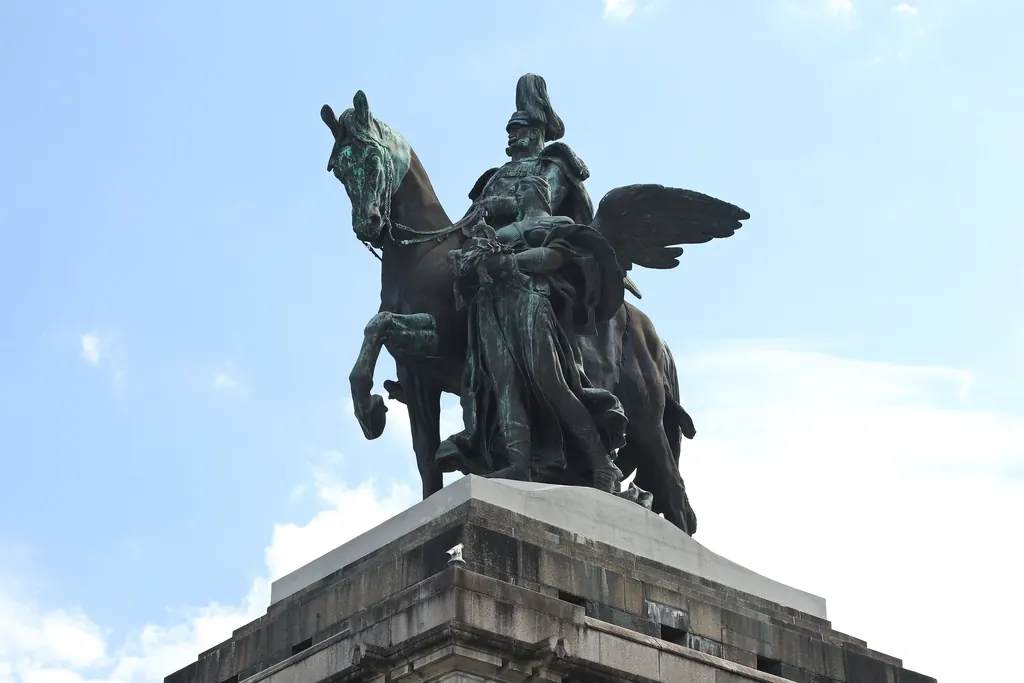
37 metres. 14 of them the rider.What stands today is a 1993 reconstruction – the original was shot to pieces by artillery in March 1945.
The Kaiser Wilhelm monument
Shortly after the death of Wilhelm I the idea arose of building the Kaiser a monument. In 1891 his grandson Wilhelm II chose the Deutsches Eck as the site. To make room, an emergency harbour at the mouth of the Moselle was filled in – only then did the headland take its present shape. On 31 August 1897 the copper monument was inaugurated in the presence of Wilhelm II.
In March 1945 artillery fire destroyed the statue. The empty plinth remained: in 1953 Federal President Theodor Heuss rededicated it as a memorial to German unity, and until 1993 a flagpole with the federal flag stood on it. In autumn 1993 a reconstruction of the equestrian statue was lifted onto the plinth. The monument is 37 metres high in total; 14 metres of that is the statue, which shows Wilhelm I with a Genius.
- Site chosen
- 1891
- Inaugurated
- 31 Aug 1897
- Destroyed
- Mar 1945
- Memorial
- 1953
- Rebuilt
- autumn 1993
- Visitors
- > 2 m a year
Since 2002 the Deutsches Eck has been part of the UNESCO World Heritage Upper Middle Rhine Valley – the same heritage zone the cable car stands in.
Rule of thumb: from the square your view reaches across the two rivers, but not over them. For the whole picture you need 112 metres more – and those are what the cable car sells.
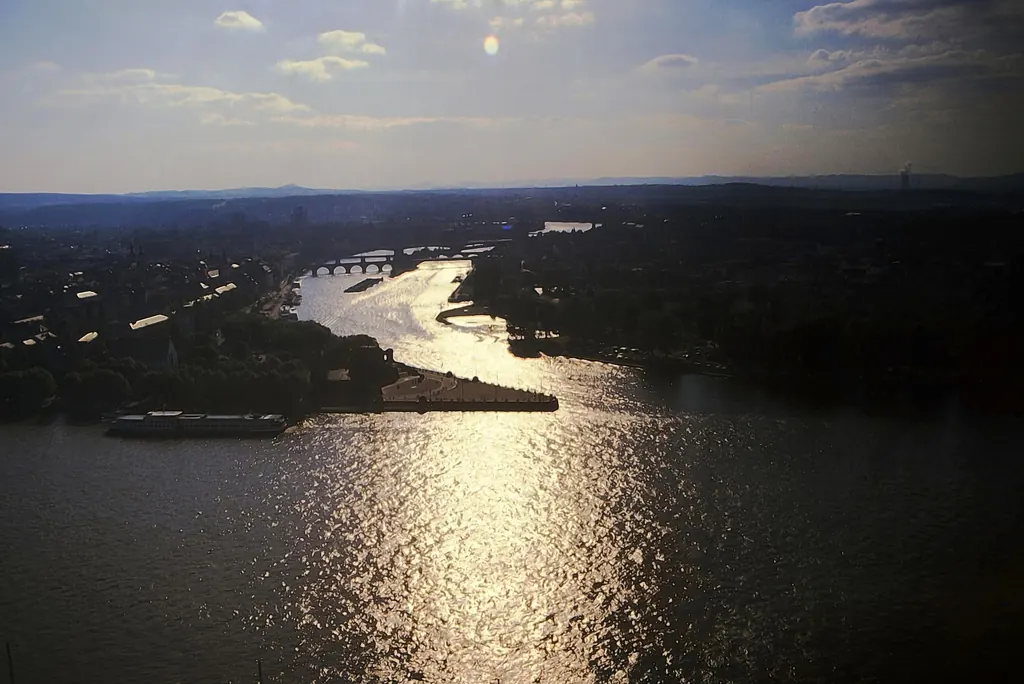
Only from above does it become a corner.In the evening the light lies on the water – and after 17:30 the cable car costs €9.90 instead of €15.50.
The view from above
The cable car’s lower station is on the Konrad-Adenauer-Ufer behind St Castor’s, within sight of the monument. From there the cabin floats 890 metres across the Rhine to the fortress; from the cabin and from the fortress wall you see the headland as a whole, with both rivers and the city behind. The return trip costs €15.50, from 17:30 €9.90. All fares: Koblenz cable car prices.
If you want the history of the place explained: Koblenz-Touristik runs city walks that take in the Deutsches Eck. On GetYourGuide there is a guided tour that includes the square:
“Who is the rider, and why is he here?”Koblenz Historic Tour “Old Town and Deutsches Eck”
Honestly: Eleven reviews is not many – the tour is new to the programme. The Deutsches Eck itself costs nothing, and if you only want the square and the monument you don’t need a guide. It is worth it for the old town on top, not for the corner alone.
Getting there and parking
From the main station, bus lines 1 and 11 run from bay D to the stop “Deutsches Eck/Seilbahn”. On foot it is about 30 minutes through the old town or along the Rhine gardens.
There is no car park at the Eck itself. The cable car operator lists four underground car parks near the lower station:
- Görresplatz car park, Josef-Görres-Platz 15
- Schloss car park, Neustadt 30
- Schängel-Center car park, Clemensstraße 26–30
- Weißer Höfe car park, Peter-Altmeier-Ufer
Honestly: “Free parking at the Deutsches Eck” is a common search, but the operator names no free space nearby for cars. What it recommends is park-and-ride: park on the edge of town and take a koveb bus into the centre. The free spaces on its list – Stresemannstraße, Pastor-Klein-Straße – are coach parks.
Where the figures come from
| Figure | Source | Checked |
|---|---|---|
| Teutonic Order 1216, “Castellum apud Confluentes”, site chosen 1891, emergency harbour, inauguration 31 Aug 1897, copper, destruction March 1945, rededication 1953 by Theodor Heuss, flagpole until 1993, reconstruction autumn 1993, 37 m and 14 m, Genius, over 2 million visitors, World Heritage since 2002 | Koblenz-Touristik, “Das Deutsche Eck” (German) | 22 Sep 2026 |
| Lower station location, bus lines 1 and 11 from bay D, stop “Deutsches Eck/Seilbahn”, car parks with addresses, park-and-ride, coach parks | Seilbahn Koblenz, getting there | 22 Sep 2026 |
| Cable car €15.50 return, evening ticket €9.90 from 17:30, 890 m length | Seilbahn Koblenz, ticket prices | 22 Sep 2026 |
| Offer price, duration and reviews | GetYourGuide partner data | 22 Sep 2026 |
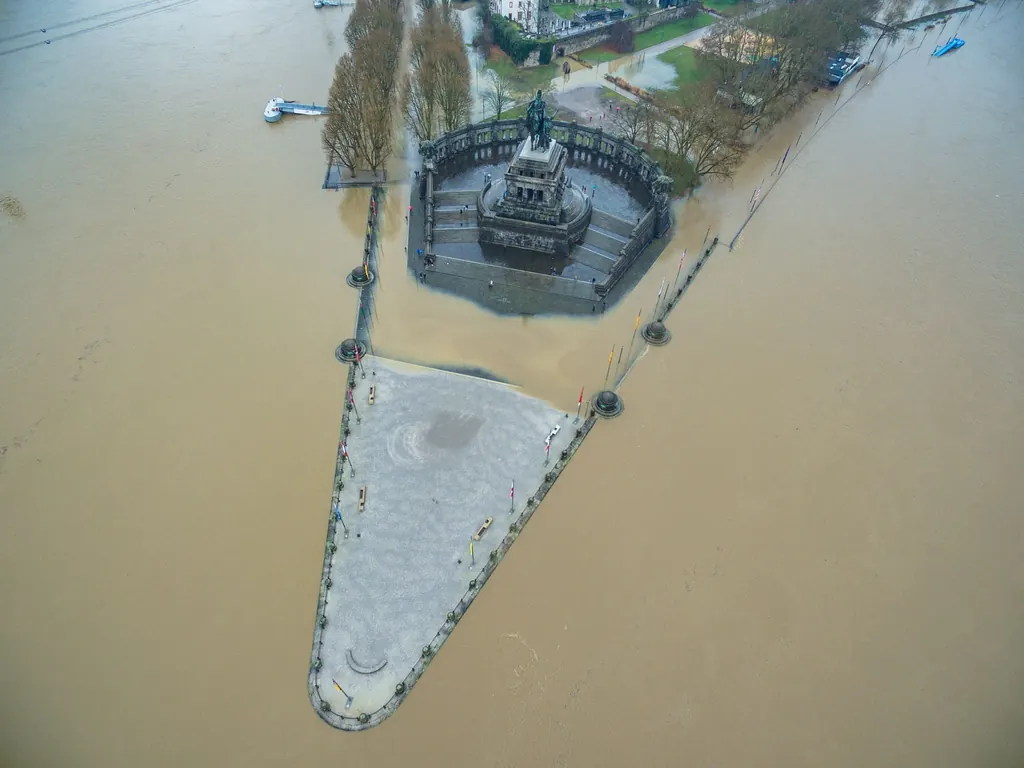
Not documented and therefore not stated: whether and when the plinth is closed during floods or events, and opening hours – the square is a public place with no entry fee.
Image credits
- Aerial view of the Deutsches Eck: Carsten Steger, CC BY-SA 4.0
- Equestrian statue: Kora27, CC BY-SA 4.0
- Evening light from the fortress: Rüdiger Stehn, CC BY-SA 2.0
- Flood of 2018: Phantom3Pix, CC BY-SA 4.0


_(18618699640).jpg)

Links to GetYourGuide are adverts: if you book through them, we receive a commission and you pay the same price. We always name the operator’s fare first. Prices change – what the provider shows is what counts.