- Summits
- Eagle's Nest
- History
Eagle's Nest · 1937 to the presentEagle's Nest history
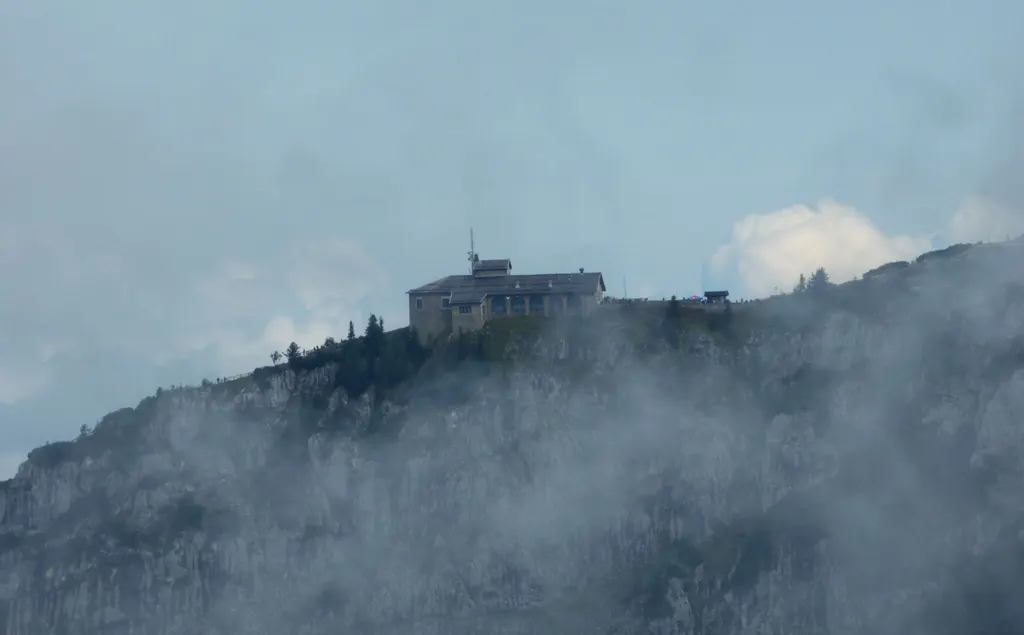
The Eagle's Nest (Kehlsteinhaus) is a building of the NSDAP, the Nazi Party, erected in 1937/38 at the instigation of Martin Bormann. Hitler was rarely there. The house gets its significance not from what happened at the top, but from the place it belongs to: Obersalzberg.
- 1937/38 construction
- 25 Apr 1945 air raid, house undamaged
- 17 May 1952 mountain restaurant
- 1960 Landesstiftung (trust)
- Hitler's visits
- around a dozen
- Days at Obersalzberg
- over 1,000
- Exhibition at the top
- in the ticket
Details checked on 21 September 2026 · Sources: Historisches Lexikon Bayerns, Dokumentation Obersalzberg / Institut für Zeitgeschichte, operator · Photo: Kajebi II., CC BY-SA 4.0, desaturated
Who built the Eagle's Nest – and what for
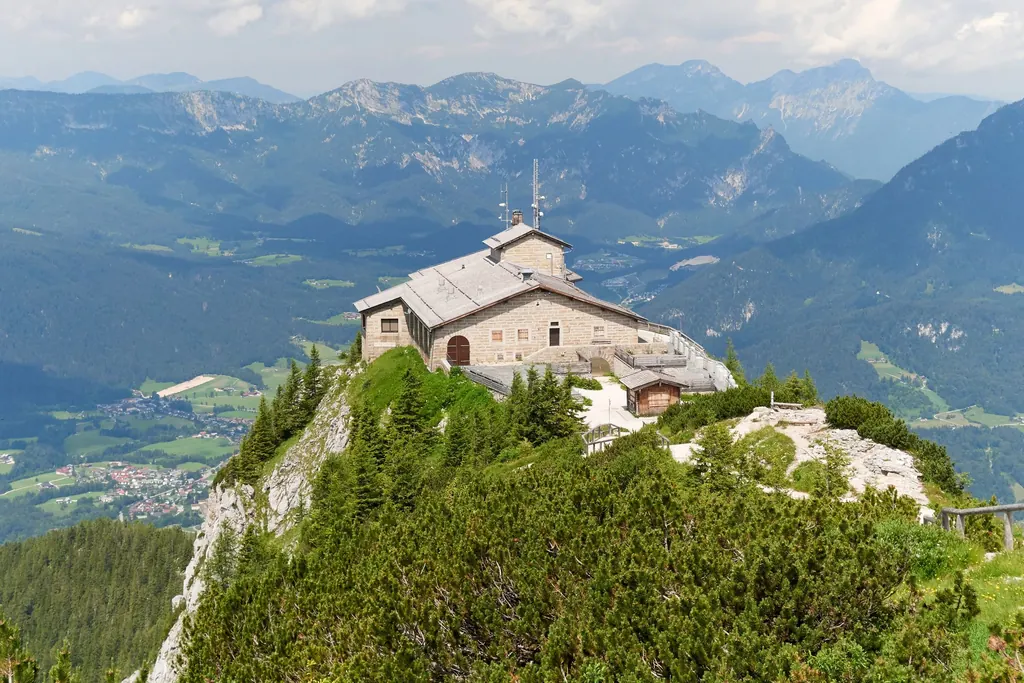
The Eagle's Nest was built in 1937/38 and completed in 1938. It was a project of Martin Bormann, who drove the development of Obersalzberg on behalf of the NSDAP. The Historisches Lexikon Bayerns (Historical Lexicon of Bavaria) describes it as a second teahouse: a first one already stood on the Mooslahnerkopf, as the destination of Hitler's afternoon walks. The second was to lie “in an even more exposed position” – on a mountain spur at an altitude of 1,834 metres.
The house was intended as a representational venue away from the public eye, for receptions for diplomats and foreign guests. For this purpose a road was built into the rock face at great expense: six and a half kilometres, 800 metres of ascent, five tunnels. From the end of the road a 124-metre-long tunnel and a lift covering a further 124 metres lead into the house.
One widespread story is not true: the Eagle's Nest was not a present for Hitler's 50th birthday in 1939. The operator points this out expressly. By that time the house had long been finished.
Many figures circulate for the construction costs, the number of workers and the construction time in months. We did not find them documented by the Institut für Zeitgeschichte (Institute of Contemporary History), in the Historisches Lexikon Bayerns or by the operator, and therefore do not give them.
Hitler and the Eagle's Nest
Hitler hardly used the house. Only around a dozen visits can be documented, and only to receive diplomats or other foreign guests. Eva Braun went up more often, with friends and guests; the Nazi entourage gathered at Obersalzberg used the house for recreation and for private celebrations. Its political significance remained slight.
Anyone looking for “Hitler's house” is therefore looking in the wrong place. The Eagle's Nest was a backdrop. Government was conducted around 800 metres lower down.
The Berghof at Obersalzberg: where government was actually conducted
Hitler came to Obersalzberg for the first time in 1923, rented Haus Wachenfeld in 1928 and bought it in June 1933. In 1935/36 it was considerably extended and from then on was called the Berghof. It became the centre of a screened-off “Führersperrgebiet” (the Führer's restricted zone). Bormann bought up the surrounding properties on the account of the NSDAP; those who did not want to sell were put under massive pressure, up to and including the threat of imprisonment in a concentration camp. In 1937 the village of Obersalzberg ceased to exist.
Between 1933 and 1944 Hitler spent more than 1,000 days at Obersalzberg – around a quarter of his time in power. After Berlin, the Berghof was the most important centre of rule of the Nazi state. When Hitler was present, war was waged from here. Decisions on persecution, war and genocide were taken at Obersalzberg; the Dokumentation Obersalzberg (documentation centre) therefore calls the place a site of the perpetrators and, in its exhibition, links it with the scenes of the crimes across the whole of Europe.
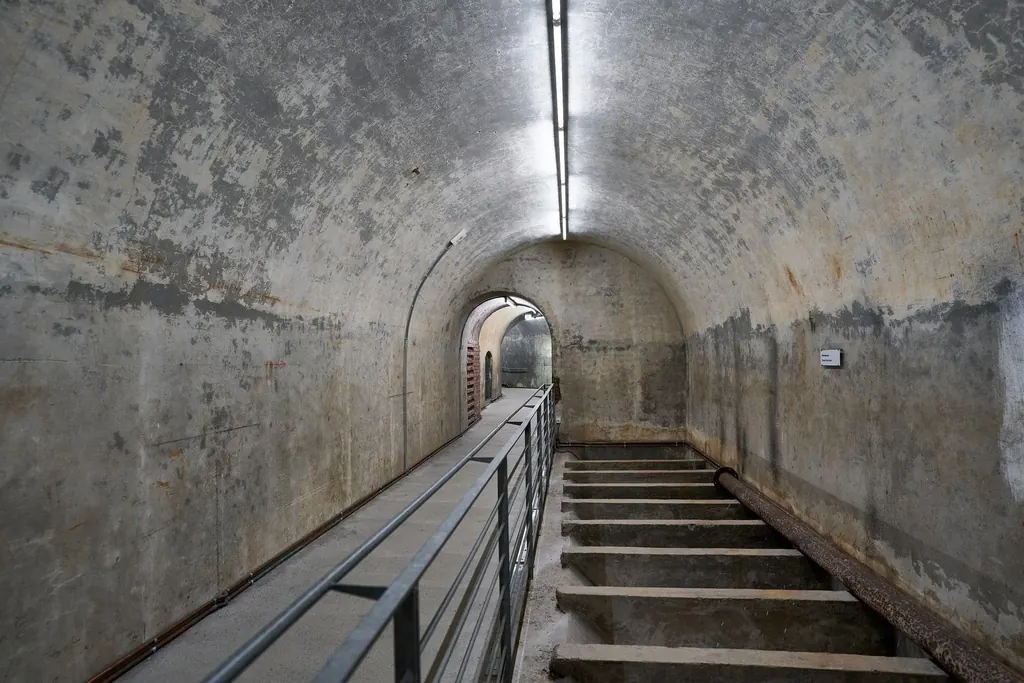
Between July 1943 and the end of the war an extensive system of bunkers was created beneath the site. It was built by several thousand forced labourers of many nationalities, who were housed in camps on and around Obersalzberg. Hitler left Obersalzberg for the last time on 14 July 1944.
1945: air raid, liberation, “Eagle's Nest”
On 25 April 1945 the British Royal Air Force bombed Obersalzberg and destroyed numerous buildings. In military terms the attack had only symbolic significance by then. The Eagle's Nest was not hit. On the evening of 4 May, troops of the French 2nd Armoured Division and the US 3rd Infantry Division reached the Berghof, which departing SS guards had previously set on fire. A little later the US 101st Airborne Division followed and was the first to push on to the Eagle's Nest. There was no more fighting.
In the English-speaking world the house is called the “Eagle's Nest”; its German name is Kehlsteinhaus. The operator and the tourism association still use the English name as a second name today. When it arose, and who coined it, is not documented in the sources we checked – so we leave out the usual anecdotes.
The Eagle's Nest then and now: from 1952 to the present
In 1949 the American occupation administration transferred the former Nazi property at Obersalzberg to the Free State of Bavaria. The burnt-out ruin of the Berghof was blown up on 30 April 1952, the site reforested and the bunker entrances bricked up – in the hope of putting an end to “Hitler tourism”. That did not succeed.
The Eagle's Nest remained standing. In parallel with the demolition of the Berghof, the US administration released it for tourism. On 17 May 1952, after alterations, it was opened as a mountain restaurant; until 1962 it was leased to the Berchtesgaden section of the German Alpine Club (Deutscher Alpenverein). In that same year, 1952, the Kehlstein road was closed to private traffic and the scheduled bus service was set up.
Since 1960 the Berchtesgadener Landesstiftung, a charitable trust, has been responsible for the house. The income from the lease and from the bus operation goes to charitable purposes in the district of Berchtesgadener Land. In 2017 more than 400,000 people travelled up.
Inside the Eagle's Nest: what can be seen of the history
Inside, the Eagle's Nest is a restaurant. Of the historic building you see the tunnel, the brass lift and the large hall with the fireplace. On the sun terrace the Institut für Zeitgeschichte shows an exhibition of 14 panels: historical photographs and texts on the transformation of Obersalzberg since 1933, on the construction of the road and the house, and on its use for tourism after 1945. It is included in the bus ticket.
Honestly: If you are coming for the history, the Eagle's Nest is the weaker part of the day. 14 panels on a terrace are no substitute for a museum – the operator itself says the exhibition is not an abridged version of the Dokumentation, but is meant to encourage a visit there. The history of this place is told down below, in the Dokumentation Obersalzberg – for €4.50, and with the Kehlstein ticket on the same day with no further admission. What else stands on the mountainside today is described on the page Obersalzberg today.
If you would like to have the history explained on the site itself: a guide leads a three-hour tour across the grounds and up to the Eagle's Nest, in English – WWII Historical Eagle's Nest Tour in Berchtesgaden Germany, from €69.90, 224 reviews (advert, GetYourGuide).
Where the information comes from
| Detail | Source | Checked |
|---|---|---|
| Second teahouse 1937/38, around a dozen visits, Eva Braun, Berghof, expulsion, more than 1,000 days, bunker construction and forced labour, 14 July 1944, air raid, 4 May 1945, 1949, demolition in 1952, Landesstiftung, visitor numbers 2017 | Sven Keller: Obersalzberg, Historisches Lexikon Bayerns (in German) | 21 September 2026 |
| Bormann's project, completion in 1938, not a birthday present, not hit, opening on 17 May 1952, Alpine Club until 1962, trust 1960, 14 panels | Kehlsteinhaus, operator's website – Geschichte (history) (in German) | 21 September 2026 |
| Representational venue, slight significance, use by the Nazi entourage, IfZ exhibition on the terrace, road, tunnel, lift, closure of the road in 1952 | Zweckverband Bergerlebnis Berchtesgaden – Kehlsteinhaus (in German) | 21 September 2026 |
| “Täterort Obersalzberg” (Obersalzberg as a site of the perpetrators) | Institut für Zeitgeschichte München–Berlin (in German) | 21 September 2026 |
| Haus Wachenfeld 1923/1928/1933, restricted zone | Dokumentation Obersalzberg – Historischer Ort (historical site) | 21 September 2026 |
| Permanent exhibition “Idyll und Verbrechen”, chapter “Täterort und Tatorte” | Dokumentation Obersalzberg – Dauerausstellung (permanent exhibition) | 21 September 2026 |
| Admission to the Dokumentation | Dokumentation Obersalzberg – Besuch (visit) | 21 September 2026 |
| Tour price, reviews | GetYourGuide, partner data | 21 September 2026 |