- Summits
- Eagle's Nest
- Obersalzberg
Berchtesgaden · around 1,000 mObersalzberg
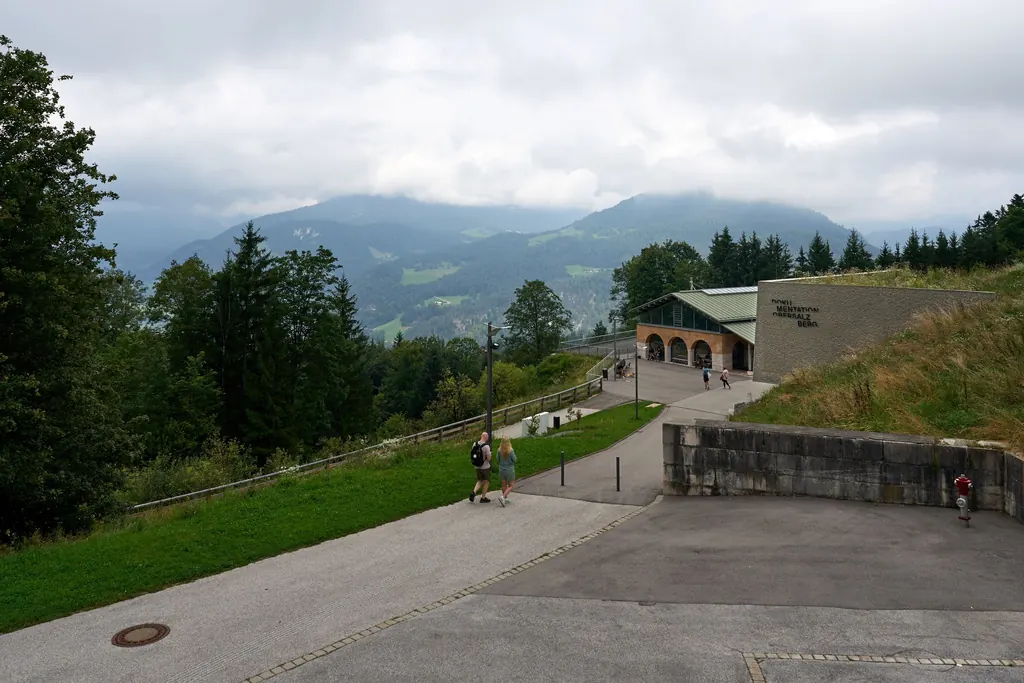
A mountainside above Berchtesgaden, between 1933 and 1945 the second centre of power of the Nazi state. Today you will find here the Dokumentation Obersalzberg (documentation centre) with the bunker complex, the departure point of the Kehlstein buses – and hardly a building left from that time.
- Documentation centre 1.5–2 hrs
- Bunker complex part of the exhibition
- Kehlstein bus departs next door
- Bus 838 from the station
- 12 min
- Documentation centre
- 09:00–17:00
- Parking
- charges apply
Details checked on 21 September 2026 · Sources: Dokumentation Obersalzberg, RVO, Historisches Lexikon Bayerns · Photo: Anil Öztas, CC BY 4.0
What Obersalzberg was
Obersalzberg lies at an altitude of around 1,000 metres above Berchtesgaden. Until the 1930s it was a village of mountain farmers with guesthouses and holiday homes, and from 1921 a recognised high-altitude climatic health resort. Adolf Hitler came here for the first time in 1923, rented Haus Wachenfeld in 1928 and bought it in 1933.
After that the mountainside was rebuilt. By 1936 Haus Wachenfeld had been extended into the Berghof, and around it a sealed-off “Führersperrgebiet” (the Führer's restricted zone) was created, with SS barracks, a farm estate and housing estates for staff. Martin Bormann bought up the plots of land for the NSDAP; those who did not want to sell were put under pressure, up to and including the threat of imprisonment in a concentration camp. In 1937 the village of Obersalzberg ceased to exist.
Between 1933 and 1944 Hitler spent more than 1,000 days here – around a quarter of his time in power. After Berlin, the Berghof was the most important centre of rule of the Nazi state. Decisions on persecution, war and genocide were prepared and taken here. That is why historians speak of a site of the perpetrators, not of a holiday residence.
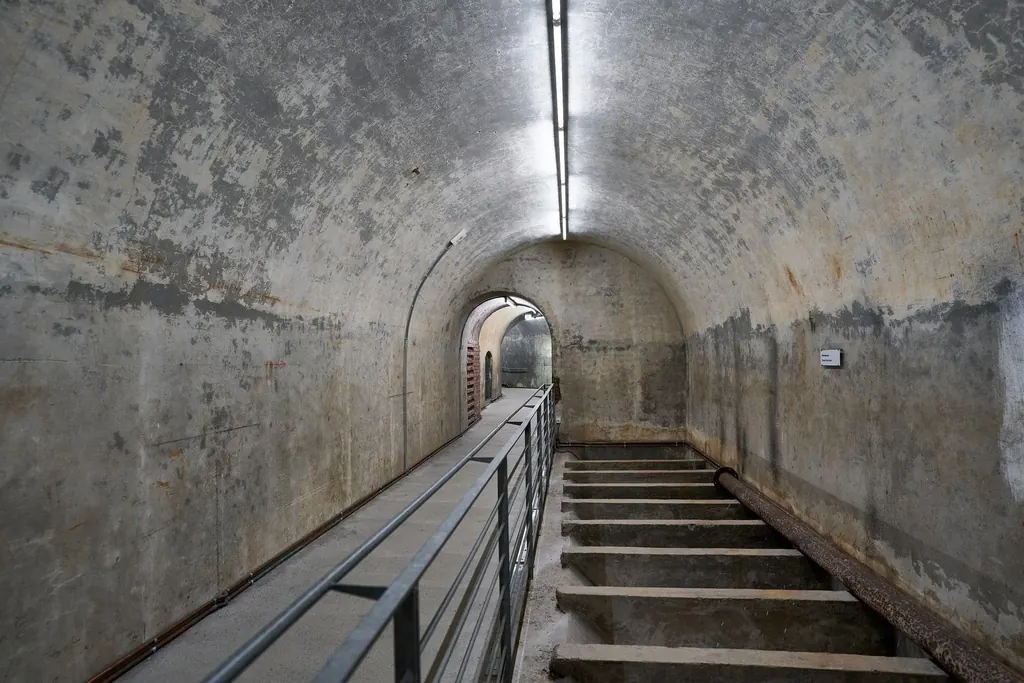
From July 1943 the party leadership had an extensive system of bunkers driven into the mountain. It was built by several thousand forced labourers from many countries, housed in camps on and around Obersalzberg. On 25 April 1945 the British Royal Air Force bombed the site; on 4 May Allied troops reached the Berghof.
Obersalzberg today: what still stands and what does not
Little. The American occupying power had the ruin of the Berghof blown up on 30 April 1952; the remaining ruins were cleared away, the bunker entrances bricked up and the site reforested. Until 1996 the US Army used parts of the area as a recreation centre. Where the Berghof stood, forest grows today; a text panel gives brief information about the place.
Anyone travelling to Obersalzberg today will therefore find three things above all:
- The Dokumentation Obersalzberg – a place of learning and remembrance run by the Institut für Zeitgeschichte (Institute of Contemporary History), opened in 1999, with a new building and the new permanent exhibition “Idyll und Verbrechen” (“Idyll and Atrocity”) since September 2023.
- The bunker complex – the largest exhibit of the exhibition, accessible via the documentation centre.
- The bus departure point for the Eagle's Nest (Kehlsteinhaus) – right next to the documentation centre. The Eagle's Nest, built in 1937/38 as a representational building, survived the air raid undamaged and has been a mountain restaurant since 1952.
Next to it, a hotel has stood since 2005, today the Kempinski Hotel Berchtesgaden. It is the second half of the “two-pillar concept” which the Bavarian state government developed after the withdrawal of the US Army: the documentation centre on one side, a hotel on the other.
Documentation centre and bunker complex: the key facts
- Open
- 09:00 – 17:00 daily
- Last admission
- 16:00
- Admission
- €4.50
- With guest card
- €3.50
- Up to 18
- free
During opening hours the bunker complex is part of the permanent exhibition and costs nothing extra. For the exhibition and bunkers the centre recommends one and a half to two hours. Everything else – guided tours, closing days, accessibility – is on the page about the Dokumentation Obersalzberg. The guest card is the card issued by your accommodation in the region.
Honestly: If you only visit the Eagle's Nest, you will learn almost nothing about this place. At the top there is a restaurant with a view. If you only have time for one of the two and the history interests you, the documentation centre is the better choice – and it costs €4.50 instead of €34.70.
Berchtesgaden to Obersalzberg: how to get up there
By bus: From Berchtesgaden station (ZOB, the central bus station) RVO route 838 runs to the stop “Dokumentation Obersalzberg”. The journey takes 12 minutes. In the 2026 summer timetable (24 May to 24 October) the first bus leaves at 07:35 Monday to Saturday, then every half hour from 09:15 to 11:15, and roughly hourly in the afternoon. On Sundays the first bus does not leave until 09:15.
By car: From the A8 motorway via Bad Reichenhall or Salzburg Süd to Berchtesgaden, then up the Obersalzbergstraße. Address for your sat nav: Salzbergstraße 45, 83471 Berchtesgaden.
| Route 838 | Mon–Fri | Saturday | Sundays/public holidays |
|---|---|---|---|
| First departure from Berchtesgaden station | 07:35 | 07:35 | 09:15 |
| Mornings | 09:15–11:15 every 30 min | 09:15–11:15 every 30 min | 09:15–11:15 every 30 min |
| Last return from the documentation centre | 18:39 | 17:39 | 17:39 |
Obersalzberg car park: where to park
You park in car parks 1 and 2 at Obersalzberg; the Kehlstein buses also depart from there. Both charge a fee; the Zweckverband (the regional tourism association) recommends the Parkster app for paying. Disabled parking spaces are marked in P2, and from there the documentation centre can be reached on the level. Coaches have to approach via the Roßfeldstraße.
Neither the operator nor the documentation centre states the amount of the parking fee on its website – it is shown on the ticket machine and in the app. Add it to the ticket price. According to the operator, Saturdays are the busiest day on the Kehlstein line. More on this under bus, getting there and car park.
How much time you should allow
- Documentation centre + bunkers
- 1.5–2 hrs
- Short tour with guide device
- 40 min
- Eagle's Nest by bus
- 2 hrs
For the Eagle's Nest the operator reckons on two hours including the journey there and back. Together with the documentation centre that is half a day; with the journey to Obersalzberg and a break, a whole one.
Rule of thumb: In clear visibility go up the Kehlstein first, then to the documentation centre – the Kehlstein ticket counts as admission there on the same day, and last admission is at 16:00. In cloud, the other way round: the documentation centre first, and the top only if it clears.
The Carl-von-Linde-Weg, an almost level walking path along the mountainside, also begins right at the documentation centre. For children, the documentation centre recommends a visit from the age of 12, or from 8 with the children's audio guide.
Where the information comes from
| Detail | Source | Checked |
|---|---|---|
| History of Obersalzberg: dates, more than 1,000 days, expulsion, bunker construction, forced labour, air raid, demolition in 1952, hotel in 2005 | Sven Keller: Obersalzberg, Historisches Lexikon Bayerns (in German) | 21 September 2026 |
| Health resort 1921, US use until 1996, opening in 1999 | Dokumentation Obersalzberg – Historischer Ort (historical site) | 21 September 2026 |
| Opening hours, admission, bunker complex | Dokumentation Obersalzberg – Besuch (visit) | 21 September 2026 |
| Length of visit, recommended age, Carl-von-Linde-Weg | Zweckverband Bergerlebnis Berchtesgaden – Dokumentation Obersalzberg (in German) | 21 September 2026 |
| New building and permanent exhibition since September 2023 | Institut für Zeitgeschichte München–Berlin (in German) | 21 September 2026 |
| Bus route 838: journey time, departures | RVO timetable route 838, valid 24 May – 24 October 2026 (in German) | 21 September 2026 |
| Approach by road, car parks 1 + 2, Parkster, busy periods, length of stay on the Kehlstein | Zweckverband Bergerlebnis Berchtesgaden – Kehlsteinhaus (in German) | 21 September 2026 |
| Disabled parking spaces in P2 | Dokumentation Obersalzberg – Barrierefreiheit (accessibility) | 21 September 2026 |
| Kehlstein ticket counts as admission, €34.70 | Fare sheet “Fahrpreise Kehlstein 2026” (in German) | 21 September 2026 |